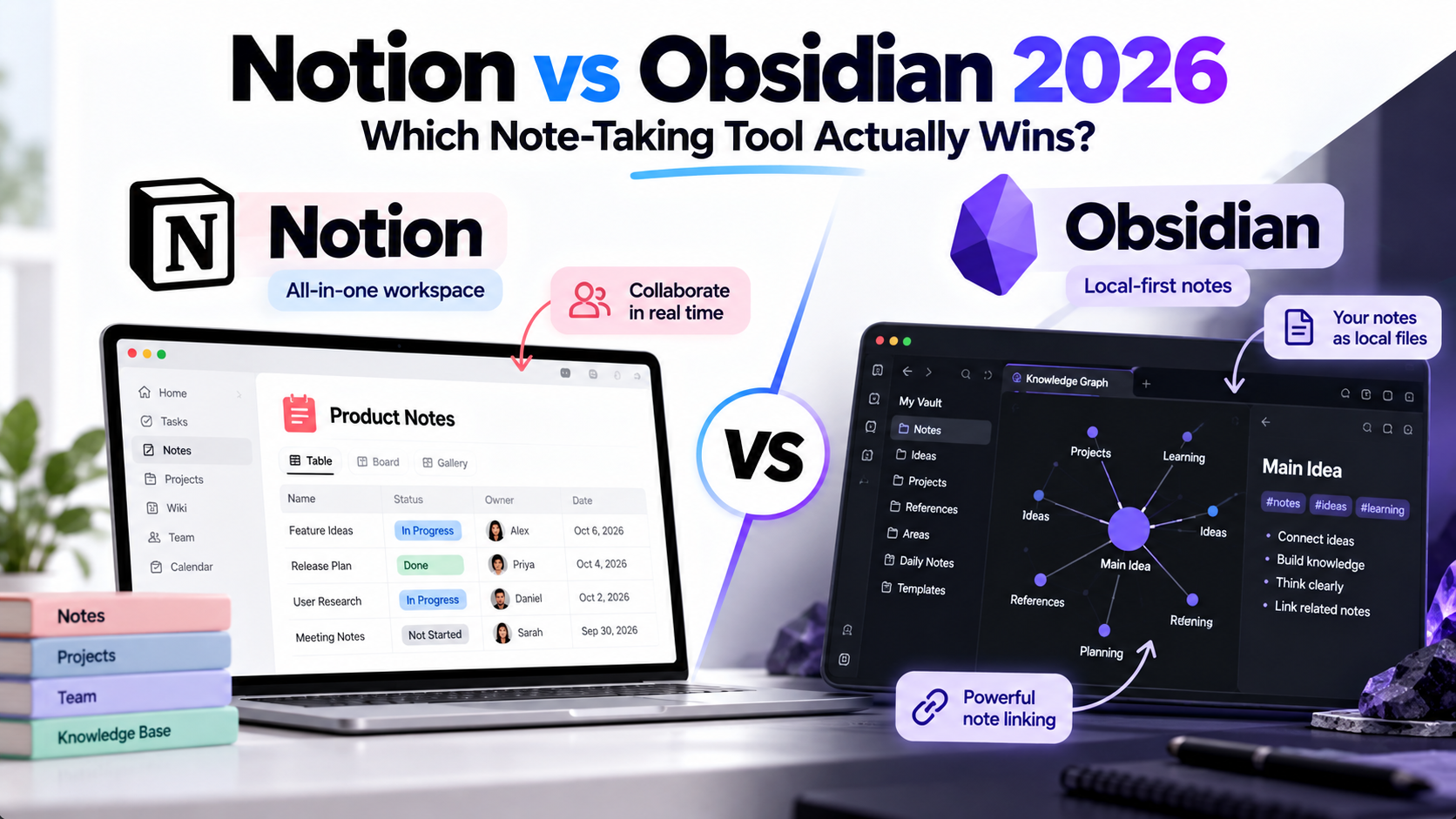
Notion and Obsidian both remain genuinely strong personal knowledge management tools in 2026, but they represent fundamentally different philosophies about where notes should actually live: Notion is a cloud-based, collaborative workspace built around structured databases and team sharing, while Obsidian stores every note as a plain local markdown file, prioritizing genuine data ownership and offline reliability over built-in collaboration. This comparison looks at data ownership, linking capability, and collaboration to help decide which philosophy genuinely fits a specific note-taking style.
Data Ownership and File Format
Obsidian’s most fundamental structural advantage is that every note exists as a genuine, portable plain-text markdown file stored locally on a user’s own device, meaning notes remain fully readable and usable even if Obsidian itself disappeared entirely someday, a genuine long-term durability guarantee that a proprietary cloud format can’t match. Notion stores notes in its own proprietary cloud database format, which means genuinely powerful database and relational features, but also means notes are considerably more locked into Notion’s own ecosystem, with export options that don’t always preserve formatting and structure perfectly. Users who prioritize long-term data ownership and the ability to read their notes with any plain-text editor decades from now tend to strongly prefer Obsidian’s file-based approach.
Linking and Knowledge Graph Visualization
Obsidian was built from the ground up specifically around bidirectional linking between notes, with a genuinely striking graph view that visualizes how an entire note collection connects, making it particularly popular among users building a personal knowledge management system based on the Zettelkasten method or similar note-linking philosophies. Notion supports linking between pages too, but its database-first structure and page hierarchy feel less naturally oriented toward the kind of freeform, associative note connection that Obsidian’s graph-first design encourages. Users specifically building a densely interlinked personal knowledge base, connecting ideas across many notes in a non-hierarchical way, tend to find Obsidian’s linking-first design a genuinely better structural fit.
Collaboration and Team Use
Notion’s clearest structural advantage is genuine, built-in real-time collaboration, letting multiple team members edit the same page simultaneously, comment, and assign tasks within a shared workspace, functionality that remains core to how Notion is used by teams rather than an afterthought. Obsidian, being fundamentally a local-first, single-user tool by design, requires third-party sync services or manual workarounds to approximate team collaboration, and even then doesn’t offer the same real-time, multiplayer editing experience Notion provides natively. Teams that need genuine shared, collaborative documentation will consistently find Notion considerably better suited to that specific need, while solo users building a personal knowledge base won’t miss Obsidian’s weaker collaboration story at all.
Extensibility and Customization
Obsidian’s plugin ecosystem, built and maintained by an active community of developers, gives genuinely deep customization potential, letting power users assemble a highly personalized note-taking workflow through dozens of community plugins covering everything from spaced-repetition flashcards to advanced formatting tools. Notion’s customization happens more through its flexible database and template system rather than a true plugin architecture, giving users genuine flexibility in how information gets structured without needing to write or install third-party code. Users who enjoy genuinely tinkering with and customizing their tool’s exact behavior tend to gravitate toward Obsidian’s plugin depth, while users who want powerful built-in flexibility without touching a plugin ecosystem tend to prefer Notion’s more contained approach.
Neither platform has definitively won in 2026; they continue to serve genuinely different priorities rather than competing head-to-head for the same user. Solo users building a genuinely long-term, densely linked personal knowledge base who prioritize data ownership and deep customization will consistently find Obsidian’s local-first, plugin-rich approach the better structural fit. Teams needing real-time collaborative documentation, alongside users who want powerful built-in database and organizational features without a plugin ecosystem to manage, will generally get more practical value from Notion’s cloud-based, collaboration-first design.
Conclusion
Notion and Obsidian both remain excellent, mature note-taking and knowledge management tools in 2026, and the right choice comes down almost entirely to whether genuine data ownership and personal knowledge linking or team collaboration matters more for a specific use case. For solo, long-term personal knowledge building, Obsidian remains the safer default, while teams needing genuine shared, collaborative documentation should give Notion serious consideration before committing to the more solo-oriented alternative.