
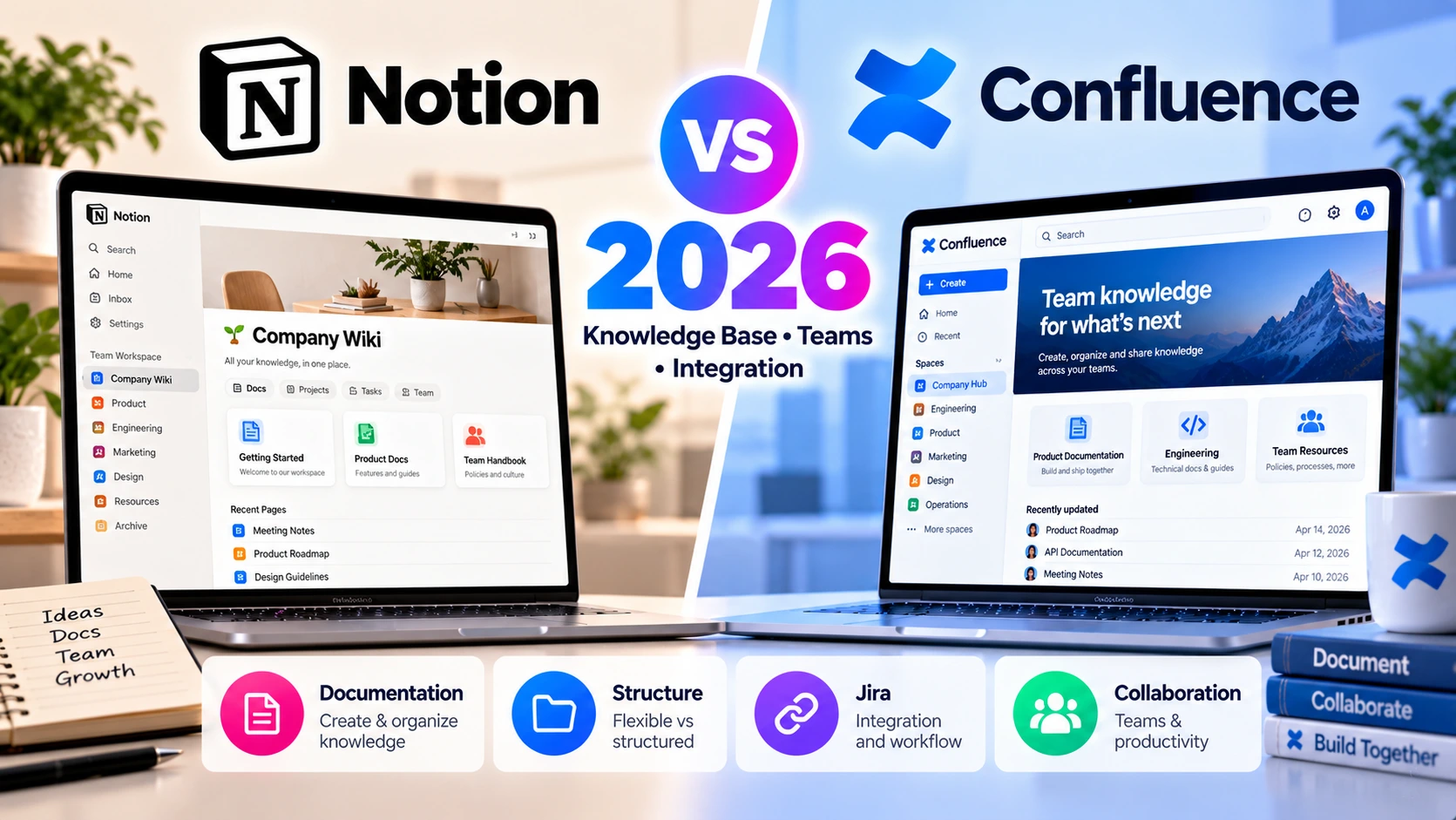
Notion and Confluence both remain genuinely strong team knowledge base platforms in 2026, but they emerged from meaningfully different origins: Notion built its reputation as a flexible, all-purpose workspace that happens to excel at documentation, while Confluence was purpose-built from the start as Atlassian’s dedicated team wiki, deeply integrated with Jira for engineering-heavy organizations. This comparison looks at ease of use, structural flexibility, and ecosystem integration to help decide which platform genuinely fits a specific team’s documentation needs.
Ease of Use and Interface
Notion’s interface remains genuinely more modern and approachable for non-technical users, with a clean, block-based editing system that lets anyone build a flexible page combining text, databases, and embedded content without needing training on Confluence’s more structured, template-heavy authoring model. Confluence’s interface has improved considerably but still carries genuine legacy complexity from its long history as an enterprise wiki tool, with a steeper learning curve for new users building their first page from scratch. Teams that want the fastest possible onboarding for non-technical staff creating and editing documentation tend to prefer Notion’s more intuitive editing experience.
Structure and Information Architecture
Confluence enforces a genuinely more structured hierarchy through its Spaces and page-tree model, which scales more predictably for large organizations with many teams each needing their own clearly bounded documentation area with defined permissions. Notion’s more flexible, database-driven structure gives individual teams genuine freedom to organize information however makes sense for their specific workflow, but that same flexibility can become genuinely disorganized at scale without deliberate, disciplined structure imposed by whoever sets up the workspace. Large organizations with many distinct teams needing clear content ownership boundaries tend to find Confluence’s more rigid structure a genuine advantage, while smaller, more agile teams often prefer Notion’s greater flexibility.
Jira and Atlassian Ecosystem Integration
Confluence’s clearest structural advantage remains its native, deeply integrated connection to Jira, letting engineering teams link documentation directly to specific tickets, epics, and sprints within the same Atlassian ecosystem they already use for project tracking. This integration matters enormously for software development teams that live inside Jira daily, since documentation and active project tracking stay genuinely connected rather than existing as two disconnected systems requiring manual cross-referencing. Notion offers its own Jira integration, but it remains meaningfully less native and deeply woven than Confluence’s built-in connection, a real consideration for engineering-heavy organizations already standardized on Atlassian’s broader toolset.
Pricing and Team Fit
Notion’s pricing remains genuinely competitive with a usable free tier for small teams and predictable per-user pricing that scales in a straightforward way as a team grows. Confluence’s pricing is often bundled favorably for organizations already paying for Jira and the broader Atlassian suite, making the combined cost of adopting Confluence alongside existing Atlassian tools frequently lower than paying separately for Notion plus a standalone Jira integration. Organizations not already using Jira or other Atlassian products tend to find Notion’s standalone pricing the more straightforward, cost-effective choice, while existing Atlassian customers will generally find Confluence’s bundled pricing difficult for Notion to beat on pure cost.
Neither platform has definitively won in 2026; they continue to serve genuinely different organizational contexts rather than competing head-to-head for the exact same buyer. Organizations already standardized on Jira and the broader Atlassian ecosystem, particularly engineering-heavy teams that want documentation tightly linked to active project tracking, will consistently find Confluence the more natural, cost-effective fit. Smaller, more agile teams or organizations without existing Atlassian investment who want a more flexible, modern, and approachable workspace for documentation alongside other work will generally get more value from Notion’s greater structural freedom and gentler learning curve.
Conclusion
Notion and Confluence both remain excellent, mature knowledge base platforms in 2026, and the right choice comes down almost entirely to existing Atlassian ecosystem investment and how much structural rigidity a specific organization actually needs. For engineering teams already living in Jira, Confluence remains the safer, more integrated default, while teams without that existing investment who want a more flexible, approachable documentation workspace should give Notion serious consideration before committing to the more structured alternative.