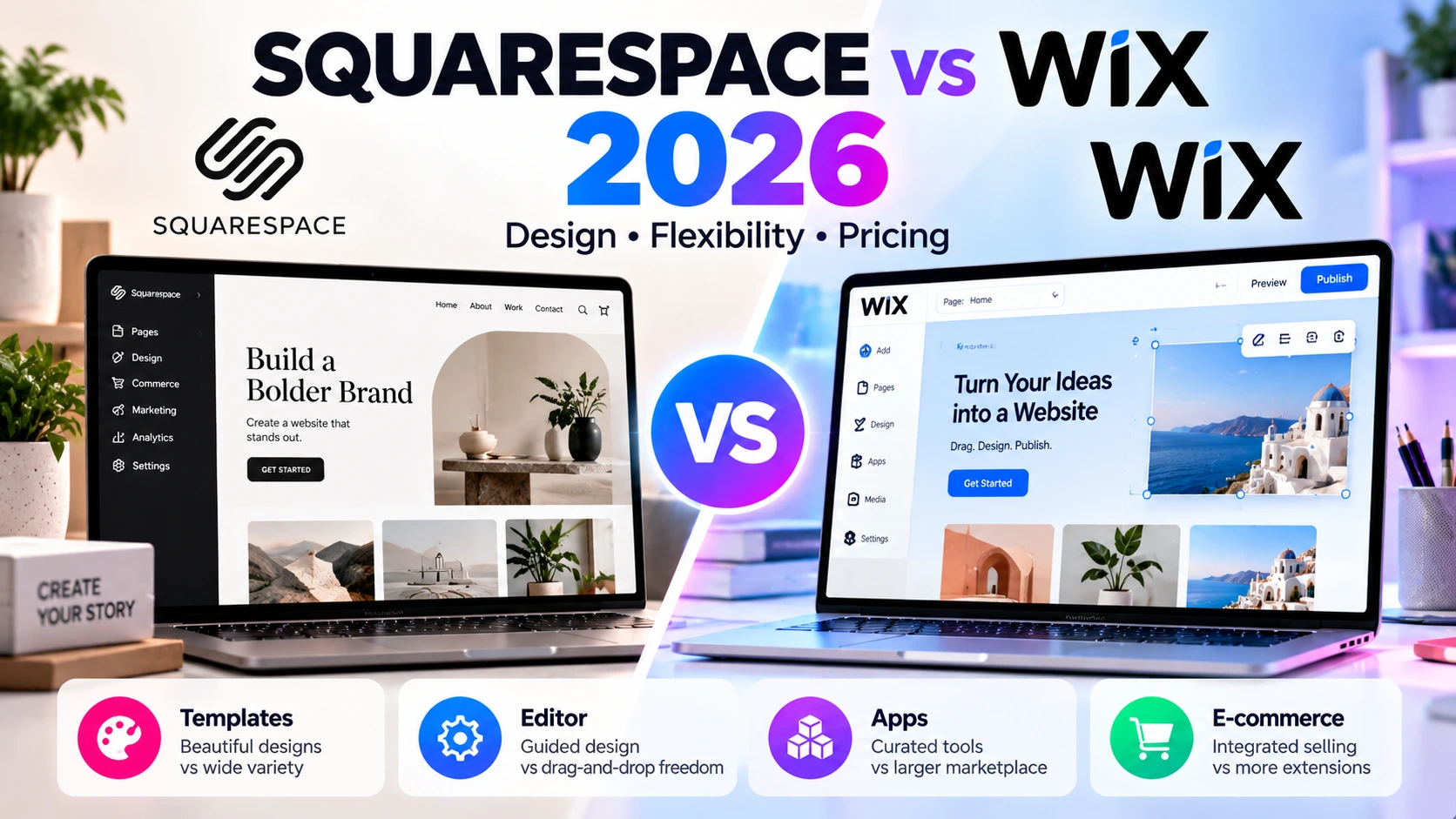
Squarespace and Wix both remain genuinely strong no-code website builders in 2026, competing for the same broad audience of small businesses, creatives, and freelancers who want a professional website without hiring a developer. The two platforms reflect meaningfully different design philosophies: Squarespace prioritizes polished, design-forward templates with somewhat more guardrails, while Wix prioritizes raw drag-and-drop flexibility and a considerably larger third-party app marketplace. This comparison looks at design quality, flexibility, and pricing to help decide which platform genuinely fits a specific project.
Design Quality and Templates
Squarespace has built its reputation specifically around genuinely beautiful, professionally designed templates that look polished immediately upon selection, appealing strongly to creatives, photographers, and small businesses that want a visually striking site without needing genuine design skill to achieve that result. Wix offers a considerably larger raw template library, with quality varying more widely across options, though its AI-powered site generator has improved considerably at producing a genuinely solid starting design based on a business description. For users who specifically want the most consistently polished aesthetic with minimal design effort, Squarespace’s more curated template quality remains a genuine, real advantage.
Flexibility and Editing Freedom
Wix’s core editor offers considerably more raw drag-and-drop freedom, letting users place elements virtually anywhere on a page with pixel-level precision, a genuine advantage for users who want granular creative control over exact layout. Squarespace’s editor imposes more structural guardrails, keeping elements within a more constrained grid system that helps preserve a template’s polished look but genuinely limits how far a design can deviate from the original template structure. Users who want maximum layout freedom and don’t mind a steeper learning curve tend to prefer Wix’s flexibility, while users who want a beautiful result without fighting the editor tend to prefer Squarespace’s more guided approach.
App Ecosystem and Extensibility
Wix maintains a considerably larger third-party app marketplace, covering a genuinely wide range of specialized functionality, from advanced booking systems to specific marketing integrations, that Squarespace’s more curated but smaller ecosystem doesn’t always match. This matters considerably for businesses with a specific, unusual functional requirement, since Wix’s broader marketplace increases the odds an existing app already solves that exact need rather than requiring custom development. For projects with genuinely standard needs, this gap matters less, but for businesses with more specialized functional requirements, Wix’s extensibility remains a real, practical advantage.
Pricing and E-Commerce
Both platforms offer genuinely competitive pricing tiers for small businesses, with Squarespace’s e-commerce plans historically favoring businesses that want a tightly integrated, design-forward online store, while Wix’s e-commerce offering has grown considerably more capable and now competes closely on features like inventory management and multi-channel selling. Squarespace’s pricing structure tends to be somewhat more straightforward and predictable, while Wix’s tiered plans and add-on app costs can accumulate less predictably for businesses that end up installing several paid marketplace apps to cover specific needs. For businesses that want the most predictable total cost, Squarespace’s simpler structure tends to be easier to budget around.
Neither platform has definitively won in 2026; they continue to serve genuinely different priorities rather than competing head-to-head for the exact same project. Creatives, photographers, and businesses that want the most consistently polished, professional aesthetic with minimal design effort will consistently find Squarespace the better fit, particularly for portfolio-style sites. Businesses that want maximum layout flexibility and access to the broadest possible library of specialized third-party functionality will generally get more practical value from Wix, even accounting for its steeper learning curve and less predictable total cost as add-on apps accumulate.
Conclusion
Squarespace and Wix both remain excellent, mature website builders in 2026, and the right choice comes down almost entirely to whether polished design simplicity or raw flexibility and extensibility matters more for a specific project. For design-forward small businesses and creatives, Squarespace remains the safer default, while businesses with specialized functional needs or a strong preference for granular layout control should give Wix serious consideration before committing to the more design-restrictive alternative.