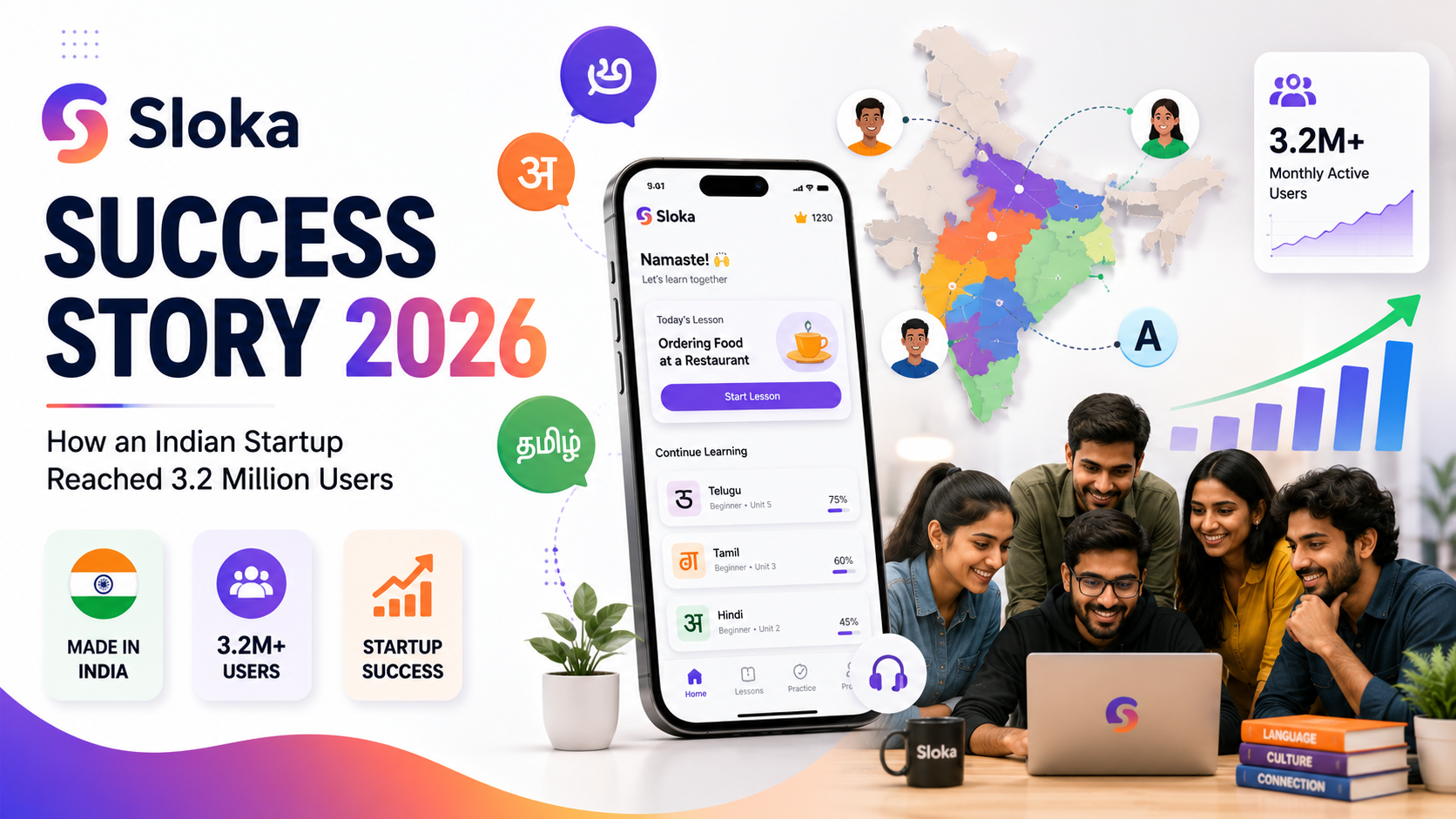
The conventional wisdom in technology has long held that Indian startups could build for India but struggled to compete with the global platforms that arrived with better-funded products, stronger brands, and established network effects. In 2026, the story of Sloka – a vernacular language learning platform built by a team of five from Hyderabad – challenges this narrative in an important way. This is the story of how they found an underserved need, built a product that international platforms had not prioritised, and grew to over three million monthly active users without a single rupee of international venture capital.
The Problem They Identified
Priya Vasudevan and her co-founder Karthik Rao met while working at a Bengaluru edtech company in 2023. Their frustration was specific and personal – as Telugu speakers who had grown up in Hyderabad, they found that every major language learning platform, including Duolingo, was built primarily around European languages with Indian languages treated as secondary markets served by stripped-down content libraries.
Duolingo offered Hindi as its primary Indian language but Telugu, Tamil, Kannada, Marathi, and Bengali users received significantly less content depth. The culturally relevant examples, the vocabulary calibrated to actual everyday Indian usage rather than textbook language, and the audio recordings from native regional speakers were all missing from international platforms serving the Indian market.
The Build – Starting from Cultural Authenticity
Rather than building a Duolingo clone with different languages, Priya and Karthik made a decision that shaped the entire product – they would build the cultural context first and the language mechanics second. Every lesson in Sloka is anchored in a real scenario from Indian daily life – ordering at a South Indian restaurant using the correct regional vocabulary, navigating a government office using appropriate formal registers, discussing a cricket match using the sporting vocabulary that actual fans use.
The vocabulary selection was informed by a corpus analysis of actual Indian social media posts, WhatsApp message samples contributed by beta users, and consultation with linguistics departments at three Indian universities. This cultural authenticity research phase took six months and significantly delayed the public launch, a decision that Priya describes as the most important one they made.
The technology stack was deliberately simple – a React Native frontend for both Android and iOS, a Node.js backend deployed on AWS infrastructure in the Mumbai region for minimum latency to Indian users, and a PostgreSQL database. The AI speech recognition for pronunciation feedback was built on open-source models fine-tuned specifically on Indian language accents rather than purchasing existing API services that had not been trained on sufficient Indian language data.
The app was built using React Native – documentation at reactnative.dev – deployed on AWS infrastructure at www.aws.amazon.com.
The Launch – Starting in Andhra Pradesh
Rather than launching nationally and competing immediately with the resources of international platforms, Sloka launched exclusively in Andhra Pradesh and Telangana in early 2025, targeting Telugu speakers specifically. The choice was strategic – by dominating a specific regional market first before expanding, they could achieve the density of users that makes a language learning community valuable without needing to spread acquisition budgets across the entire country simultaneously.
The go-to-market approach was offline and digital simultaneously. Partnerships with fifty regional colleges and universities in Andhra Pradesh provided institutional distribution that no national app marketing budget could replicate at equivalent cost. Students enrolled in language improvement programmes through their institutions, creating a base of engaged users who represented the core target demographic.
The digital component used Telugu-language content on YouTube and Instagram – not English-language content about a Telugu app, but actual Telugu content made by Telugu creators that reached Telugu speakers organically. The organic reach of culturally relevant content in regional languages proved significantly more cost-effective than English-language digital advertising targeting regional language speakers.
The Growth – Beyond Andhra Pradesh
By mid-2025, Sloka had reached 500,000 monthly active users in Andhra Pradesh and Telangana. The decision to expand into Tamil Nadu required building an entirely new Tamil language curriculum from scratch rather than simply translating existing Telugu content – a significant content investment that the team treated as a second launch rather than an extension of the first.
The Tamil launch reused the institutional partnership model developed in Andhra Pradesh, partnering with colleges across Tamil Nadu before any public app store marketing. The pattern repeated – organic regional content, institutional anchors, and authentic cultural vocabulary built the Tamil user base at similar speed to the Telugu market.
By June 2026, Sloka was operating in six regional language markets with 3.2 million monthly active users. The revenue model – a freemium structure with premium features at 199 rupees per month or 999 rupees per year, priced specifically for Indian affordability – had achieved sustainable unit economics at this scale without any external fundraising.
How They Competed With Global Platforms
Priya’s analysis of why Sloka succeeded where many India-focused edtech startups have struggled centres on a single principle – they built for the specific cultural reality of their users rather than adapting a globally standardised product for an Indian market as an afterthought. Duolingo, with hundreds of millions in funding and thousands of employees, cannot pivot its entire product philosophy to serve Indian regional language users with the authenticity that a team of five Telugu speakers built from day one.
The global platforms’ strength – scale, funding, and brand recognition – is less valuable than authenticity when the product category requires deep cultural knowledge. Sloka’s team could write curriculum content that felt natural to Telugu speakers in Andhra Pradesh because they were Telugu speakers from Andhra Pradesh. No amount of funding can substitute for that in-group authenticity for this specific product type.
Lessons for Indian App Developers in 2026
The Sloka story suggests several principles worth internalising for any Indian developer considering whether to build for global markets or for India specifically. Serving an Indian need that international platforms underserve is more defensible than competing with international platforms at their own game. Starting with one specific regional community and dominating it before expanding produces stronger unit economics and more sustainable growth than national launches competing against better-funded alternatives from day one. And building cultural authenticity into the product architecture from the beginning is more valuable than speed to market with a culturally generic product that can be adapted later.
For Indian developer community resources visit www.nasscom.in and www.startupindia.gov.in