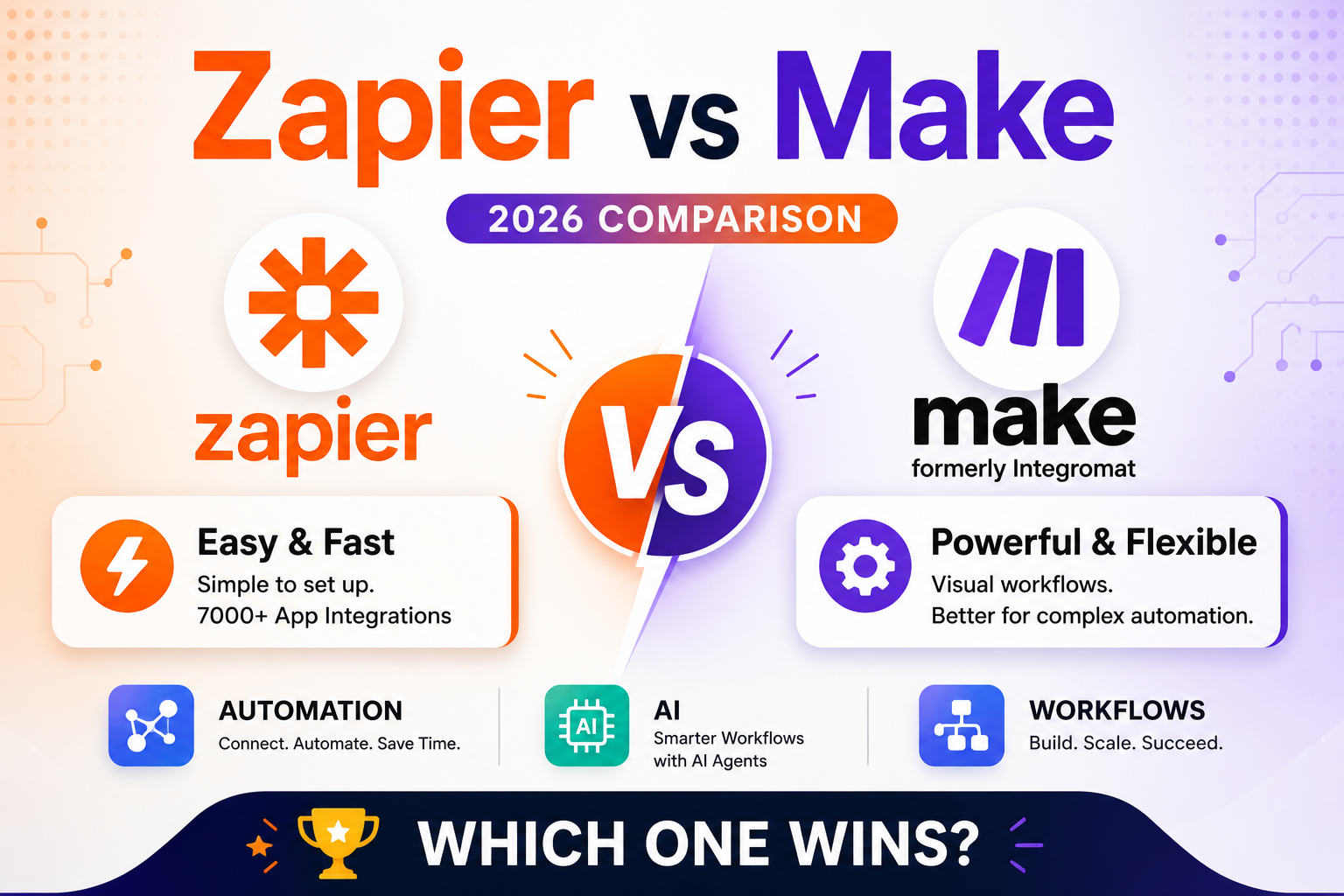
Zapier and Make, formerly known as Integromat before its 2022 rebrand, remain the two dominant names in no-code workflow automation, connecting apps together so repetitive tasks happen automatically rather than requiring manual work every time. Both platforms have evolved considerably since their early rivalry, and 2026’s versions reflect genuinely different underlying philosophies about how automation should be built, Zapier prioritizing simplicity and breadth, Make prioritizing visual complexity and value at scale. This comparison looks at ease of use, integration breadth, complex logic handling, and pricing to help teams pick the platform that actually fits their technical comfort level and automation ambitions.
Ease of Use and Setup
Zapier remains the clear winner on initial ease of use, following a straightforward trigger-then-action model that non-technical business users can grasp within minutes, and its Zap AI feature lets users describe an automation in plain English to get a working starting point without touching any configuration manually. Make’s visual, flowchart-style scenario builder looks considerably more like a mind map than a simple form, which gives it genuine power for complex logic but comes with a real learning curve that intimidates users expecting something as simple as Zapier’s linear list-based approach. For teams that want automation without anyone needing to become an automation specialist, Zapier’s gentler on-ramp remains a meaningful practical advantage regardless of Make’s deeper underlying capability.
Handling Complex Logic
Make’s visual scenario builder genuinely outperforms Zapier once an automation needs real branching logic, iterators, aggregators, custom API calls, or multi-step conditional routing, capabilities that push well past what Zapier’s simpler trigger-then-action model was originally built to handle gracefully. A side-by-side test building the same moderately complex automation, checking a CRM for an existing lead, creating one if missing, sending a personalized email, and logging the result to a spreadsheet, consistently favors Make for teams comfortable with its steeper interface, since the flowchart structure maps naturally onto genuinely branching workflows in a way Zapier’s linear Zaps start to strain against. For straightforward, single-path automations, this difference matters far less, but for genuinely complex, multi-branch business processes, Make’s architecture holds up better.
Integration Breadth and AI Features
Zapier maintains a substantially larger app library, connecting to more than 7,000 apps compared to Make’s roughly 1,000 to 1,500, a meaningful gap for any team relying on a niche or newer SaaS tool that may only ever ship an official Zapier integration. On the AI front, Zapier has positioned itself more explicitly as an AI orchestration platform in 2026, letting AI agents act directly on connected apps through chatbots, coding tools, or terminals without needing every automation pre-designed in advance, while Make requires automations to be more fully built out ahead of time before an agent can trigger them. Teams building AI-agent-driven workflows that need to act flexibly across many apps in real time will find Zapier’s more mature natural-language automation building and agent orchestration meaningfully ahead of Make’s current capability in this specific area.
Pricing at Scale
Make’s pricing model rewards high-volume users considerably better than Zapier’s, with paid plans starting around $9 a month compared to Zapier’s roughly $20 a month, and at comparable operation volumes Make frequently ends up three to five times cheaper once usage scales up meaningfully. This makes Make the stronger economic choice specifically for AI-heavy workflows that call a language model, parse the response, and take several downstream actions per execution, since each of those steps consumes a task or operation credit that adds up quickly at real volume on Zapier’s pricing structure. For lower-volume automations where the difference in absolute dollar terms stays small, Zapier’s ease of use and larger integration library often justify its higher per-operation cost regardless of the raw pricing gap.
The honest takeaway in 2026 is that neither platform has definitively won; they continue to serve genuinely different segments of the same broad automation market rather than competing head-to-head for the exact same buyer. Non-technical business teams that want automation working in minutes with the widest possible app support should default to Zapier despite the higher per-operation cost, while technical teams building genuinely complex, branching, high-volume automations will consistently find better value and more appropriate tooling in Make’s visual scenario builder. Some teams end up using both simultaneously, Zapier for simple, broad-reaching automations and Make for a handful of genuinely complex, high-volume workflows, rather than trying to force every use case through a single platform.
Conclusion
Zapier and Make both remain excellent, mature no-code automation platforms in 2026, and the right choice comes down almost entirely to a team’s technical comfort level and the actual complexity of the workflows being automated. For most non-technical teams prioritizing ease of use and the widest app support, Zapier remains the safer default, while technical teams building complex, high-volume, or AI-heavy automations should give Make’s visual builder and more favorable per-operation pricing serious consideration before committing to the more familiar name.